How to manage coffee stock by lot, bags, weight, ownership, and location
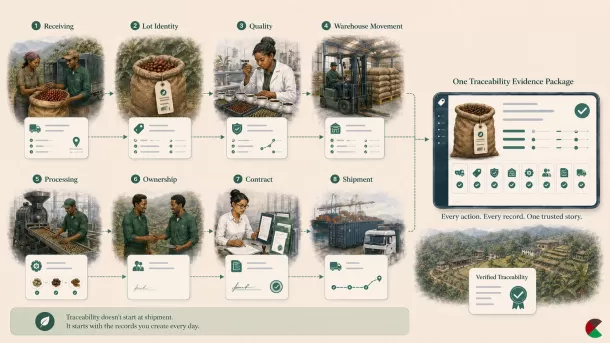
Coffee stock is not one number. A useful warehouse record must explain which lot exists, how many bags and kilograms remain, who owns it, where it is held, and what is already reserved or committed.
A balance needs context
A statement such as “we have 500 bags” is rarely enough.
The business needs to know which coffee those bags represent, what bag size is being used, the actual weight, whether the stock is owned by the company or a customer, where it is physically located, and whether some of it is already reserved for processing or export.
Without these dimensions, a total can be numerically correct and operationally misleading.
Lot identity
The lot is the persistent reference connecting the physical coffee to its operational history.
A useful lot record may include coffee type, origin, crop year, process, grade, owner, initial bag and weight information, quality context, and relationships to receiving, processing, transfer, sample, contract, or shipment records.
Lot identity should remain stable even when the coffee moves or its available balance changes.
Bags and kilograms
Coffee is discussed in bags, but bag sizes vary and physical weight may differ from a simple nominal calculation.
The stock system should therefore preserve both bag count and kilograms, together with the unit or bag size used by the business. Validation can identify unreasonable relationships while allowing legitimate operational variation.
Processing, rebagging, split, merge, and correction workflows must also respect the relationship between business bag counts and physical weight.
Ownership
Stock in the warehouse may belong to the operating company, a supplier, a customer, or another party.
Ownership should be explicit and traceable. A transfer of ownership is different from a physical movement. The coffee can remain in the same warehouse location while the owner changes, or it can move without changing ownership.
Keeping these events separate prevents confusion in stock reporting and financing discussions.
Location and movement
The system should show where the coffee is held and how it arrived there.
Receiving, internal transfer, processing, return, issue, and correction movements create the location history. A current balance is easier to trust when the user can follow the movements that produced it.
Available, reserved, and committed
Physical presence does not always mean operational availability.
Stock may be reserved for processing, allocated to a contract, held for a customer, or otherwise unavailable for a new use. Reports should distinguish total physical stock from free or available stock and should explain the records creating the reservation or commitment.
Physical count and correction
Periodic counting remains necessary.
When a count differs from the system, the correction should be approved and recorded as an event with a reason, date, responsible user, and effect on bags and kilograms. Replacing the old balance silently removes the history needed to understand the difference.
A practical warehouse discipline
Good coffee stock control depends on consistent receiving, lot naming, unit rules, ownership recording, movement confirmation, reservation logic, and count procedures.
Software can enforce and connect these practices, but the organization must still define who is responsible for each event and how exceptions are approved.