Why coffee traceability must begin with daily operational records
Traceability is difficult when it is treated as a report to prepare at the end. It becomes more dependable when source, lot, movement, processing, quality, and shipment evidence are recorded during normal work.
Traceability cannot repair records that were never created
A final traceability report can only be as reliable as the events recorded before it.
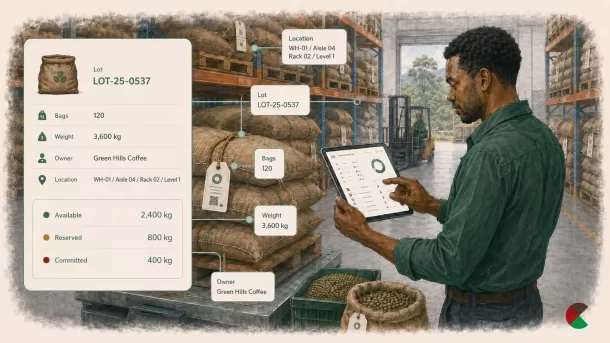
If receiving did not identify the supplier or source, later reports cannot confidently recreate that fact. If processing inputs and outputs were not recorded, the relationship between lots becomes uncertain. If ownership changes were handled informally, the system cannot explain who held the coffee at a particular time. If shipment records are detached from the allocated lots, the evidence chain ends before export.
Traceability therefore begins with operational discipline.
The minimum connected events
A practical traceability foundation may include:
- source or supplier identity;
- purchase and receiving records;
- origin, crop year, process, grade, and other classifications;
- lot identity;
- bag count and weight;
- warehouse location and movement;
- quality and sample records;
- processing input and output relationships;
- split, merge, transfer, and ownership events;
- contract allocation;
- export and shipment evidence.
Not every customer or regulation will require the same presentation, but these events provide the operational truth from which evidence can be prepared.
Record the event when it happens
Retrospective data entry increases the risk of missing or reconstructed information.
The strongest workflow records the event at the point where responsibility is clear: receiving at intake, lab evaluation during quality work, movement during warehouse handling, processing when transformation occurs, allocation during commercial fulfilment, and shipment evidence during export execution.
This does not mean every user enters everything. It means each role records the part of the process it owns.
Reconciliation is part of traceability
A trace graph should not be accepted simply because it looks complete.
Bag counts, kilograms, source quantities, processing inputs, outputs, losses, splits, merges, and issues need to reconcile within reasonable operational rules. Coverage checks and diagnostics help identify where evidence is incomplete or inconsistent.
This is especially important when migrating historic data or integrating records created under earlier operating practices.
EUDR readiness, not certified compliance
Connected operational records can support EUDR readiness by making source, lot, transformation, and shipment evidence easier to assemble and review.
The responsible organization must still determine the legal requirements that apply to its products, markets, suppliers, geolocation information, due-diligence process, and declarations. Software can support evidence management; it does not certify compliance by itself.
Start with one traceable workflow
A practical implementation may begin with one product flow, one warehouse, one export process, or one customer requirement.
The team can test whether receiving, lot identity, processing, ownership, and shipment records remain connected. Gaps can be corrected before the approach expands to the rest of the operation.