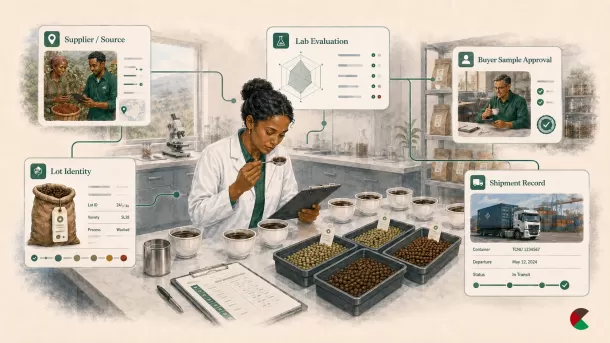
From scattered records to one dependable coffee operating history
Coffee businesses rarely lack records. The real problem is that purchase, quality, stock, processing, export, and shipment records often live in separate places. coefex is designed to connect those records into one usable operational history.
The problem is fragmentation, not absence of data
Most coffee businesses already record a great deal: supplier details, purchase quantities, lot references, lab results, warehouse movements, processing outputs, contracts, packing information, shipment status, and financial follow-up.
The difficulty is that these records are often separated by department, spreadsheet, paper file, messaging thread, or software tool. A warehouse balance may be correct, but the commercial team cannot immediately see which contract is using it. A lab result may exist, but it is not connected to the final shipment. A shipment file may be complete, but the source and processing history must still be reconstructed manually.
This fragmentation creates follow-up work. Teams spend time asking where a document is, which lot was used, whether stock is still available, who owns it, and whether a figure in one report matches another.
An operating history is more useful than a document archive
A dependable operating history does more than store documents. It connects events in the order they happened.
A receiving creates stock and lot identity. Lab work adds quality context. Warehouse movements show where the coffee is held. Processing records explain transformation. Contract allocation links physical stock to a commercial obligation. Export documents and shipment records explain how the coffee left the business.
When these events are connected, a user can understand the current position and also reconstruct how that position came to exist. That is useful for daily management, customer communication, financing discussions, audit preparation, and traceability readiness.
What coefex connects
coefex is built around practical coffee operations rather than a generic document repository. Depending on the selected scope, the platform can connect:
- supplier and sourcing records;
- purchase intake and receiving;
- samples, evaluations, defects, descriptors, and scores;
- lots, bags, weight, ownership, and warehouse location;
- processing inputs, outputs, splits, merges, and transfers;
- buyers, contracts, allocations, and export documentation;
- packing, shipment status, and trade evidence;
- dashboards, reports, partner visibility, and management review.
The goal is not to make every user work in every area. Each team works in the workflows relevant to its role, while the underlying records remain connected.
Why this matters for trust
Trust is easier when operational information can be explained.
A buyer may want confidence in quality, origin, and shipment preparation. A lender may need controlled visibility into stock, commitments, and movement history. A manager may need to understand delays and open work. A warehouse team needs clear lot identity and available quantity. A compliance team needs evidence that can be assembled from recorded operations.
The same connected history can support each of these needs without giving every external party access to operate the system.
A practical starting point
A business does not need to connect everything on the first day. A focused first phase may begin with sourcing and receiving, lab and sample management, warehouse control, export documentation, or shipment follow-up.
The important point is to begin with a workflow where operational gaps are visible, prove the value of a connected record, and then extend from a stable foundation.